Introduction
The Cyberinstitute of the State of New York (CSNY) was approved in June of 2006 by the
Center of Excellence in Bioinformatics and Life Sciences. Delays in the
announcement of CSNY and its establishment have led to the creation of the
CyberInstitute (CI). CI projects
are currently supported by an NSF ITR grant, an NSF CRI grant, and the
Center of Excellence's Center for Computational Research.
In the 21st century, leading academic institutions will
embrace our digital data-driven society and empower students to compete in this
knowledge-based economy. In order to support research, scholarship, education,
and community outreach, CSNY has been established to integrate research in
disciplinary domains, including science, engineering, and biomedicine, with
research in enabling technologies and interfaces. This will allow students and
scientists to transparently collect, manage, organize, analyze, and visualize
data without having to worry about details such as where the data is stored,
where the data is processed, where the data is rendered, and so forth. This
ease of use and high availability of data and information processing tools will
allow for revolutionary advances in all areas of science, engineering, and
beyond.
Cyberinfrastructure sits at the core of modern simulation
and modeling, which allows for entirely new methods of investigation that allow
scholars to address previously unsolvable problems. Specifically, the
development of necessary software, algorithms, portals, and interfaces that will
enable research and scholarship by freeing end-users from dealing with the
complexity of various computing environments is critical to extending the reach
of high-end computing, storage, networking, and visualization to the general
user community.
CSNY will consist of four key components. Namely, (i) the
world-class high-performance computing center, the
Center for Computational Research, (ii) an extensive cadre of researchers
who rely on simulation and modeling, (iii) a set of scientists who are at the
forefront of research in enabling technologies, including networking, data
mining, and user interfaces, and (iv) a set of staff programmers who will bridge
the gap in the aforementioned areas to turn fundamental research into tools
available to the world.
- the Center for Computational Research,
a high-performance computing center,
- an extensive cadre of researchers who rely on simulation and modeling,
- a
set of scientists who are at the forefront of research in enabling technologies,
including networking, data mining, and user interfaces, and
- a set of staff programmers who will bridge the gap in the aforementioned
areas to turn fundamental research into tools available to the world.
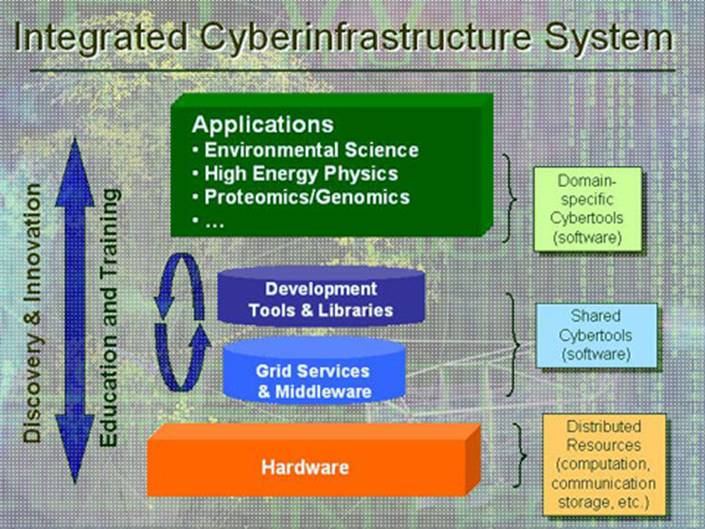
An illustration of Integrated
Cyberinfrastructure from NSF Director Arden Bement is
given below. With the reorganization of NIH and NSF to
directly include support for high-end computing and
cyberinfrastructure, it has been calculated that up to
$7B of new funds are available for research in these
areas.
The Director of the CyberInstitute is Dr. Russ Miller, founding
director of CCR, UB Distinguished Professor of Computer Science and Engineering,
and Research Scientist at the Hauptman-Woodward Medical Research Institute. Dr.
Miller’s publications and presentations number approximately 300, including
scientific peer-reviewed papers, chapters, and abstracts of presentations at
national or international conferences. Dr. Miller has published in the areas
of parallel algorithms, parallel architectures, grid computing, and molecular
structure determination. |