|
Last Update: Thursday, 31 July 2014
Note: |
|
Last Update: Thursday, 31 July 2014
Note: |
For instructions on how to access articles from
certain journals (notably Psychological Review)
from buffalo.edu machines,
link to:
"Classic (Online) Readings in Cognitive Science"
"[T]he task of the brain, when viewed from a certain distance, can seem impossible: it must discover information about the likely causes of impinging signals without any form of direct access to their source. …[A]ll that it ‘knows’, in any direct sense,…[is] the ways its own states (e.g., spike trains) flow and alter. In that (restricted) sense, all…[it] has direct access to is its own states. The world itself is thus off-limits. …Notice how different this conception is to ones in which the problem is posed as one of establishing a mapping relation between environmental and inner states. The task is not to find such a mapping but to infer the nature of the signal source (the world) from just the varying input signal itself. [§1.2, p. 183.]
"If ["perception is indirect" (J. Hohwy, "Functional Integration and the Mind", Synthese 159(3) (2007): 315–328)]…, then the role of perceptual contact with the world is only to check and, when necessary, correct the brain's best guessing concerning what is out there.
"Nevertheless, we may still reject the bald claim that ‘what we perceive is the brain's best hypothesis.’ …[W]hat we perceive is not some internal representation or hypothesis but (precisely) the world." (§4.4, p. 200.)
"[T]he brain is a creativity machine, which obtains incomplete information from the outside world and completes it."
"[T]hese findings [about "neural correlates for illusions involving senses other than vision, such as hearing and touch"] demonstrate that we have no direct contact with reality. Our brain is always abstracting and interpreting the world around us."
"Open a standard textbook on neurobiology and you will find somewhere an illustration with an eye on one side and the primary visual cortex on the other. Signals flow from the eye's retina to the optic chiasm; then on to the lateral geniculate, explained as a kind of way station; and then to the primary visual cortex. It is a comfortable diagram. We engineer such systems, with a few modules lined up from left to right, with information flowing through them.
The trouble is, neurobiology textbooks also note that 80% of the input to the lateral geniculate comes from somewhere other than the retina. A good deal comes down from the primary visual cortex, suggesting that vision is a matter of guided hallucination. Other substantial input comes from auditory apparatus. Everything is all mixed up, with information flowing bottom to top and top to bottom and sideways too. It is a strange architecture about which we are nearly clueless."
"Light bouncing off stuff is what we see."
"The ‘magic’ of consciousness is that we think we are experiencing the world through our eyes and ears, but really everything is seen and heard in the brain."
"Reality is a tape-delayed broadcast, carefully censored before it reaches us."
"Our perceptions…are fantasies we construct that correlate with reality."
"Your brain, after all, is encased in darkness and silence in the vault of the skull. Its only contact with the outside world is via the electrical signals exiting and entering along the super-highways of nerve bundles. Because different types of sensory information (hearing, seeing, touch, and so on) are processed at different speeds by different neural architectures, your brain faces an enormous challenge: what is the best story that can be constructed about the outside world?"
"My phenomenal world…[is] a neural fiction perpetrated by the senses."
"It is a gross mischaracterization to say that we simply open our eyes and take it all in; what we are in contact with is a constructed product of many different brain processes."
"Biological systems have available through their senses only very limited information about the external world. Yet these systems make strong assertions about the actual state of the world outside themselves. These assertions are of necessity incomplete. Clearly, a [complete] replica of an object and its qualities cannot be embodied within the brain. How can an incomplete description, encoded within neural states, be sufficient to direct the survival and successful adaptive behavior of a living system?"

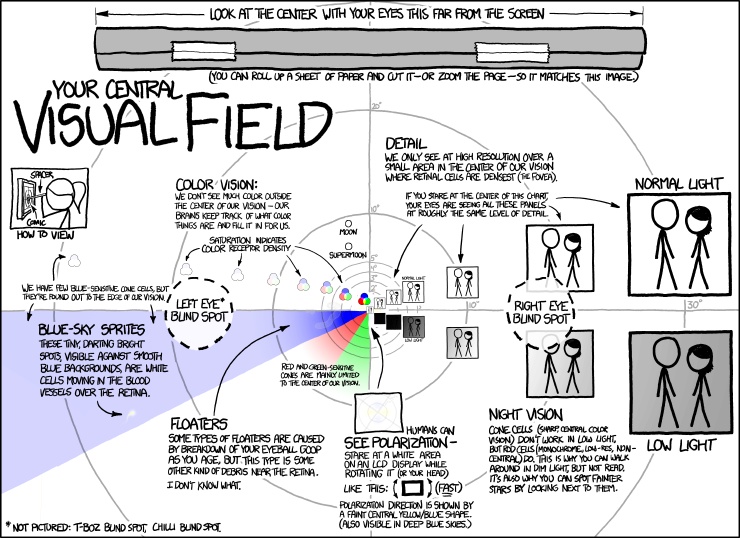
For more on the limitations and distortions of vision, watch: Vsauce (2013), "What Does Earth Look Like?" (11 November).


 or
or  material is highlighted


